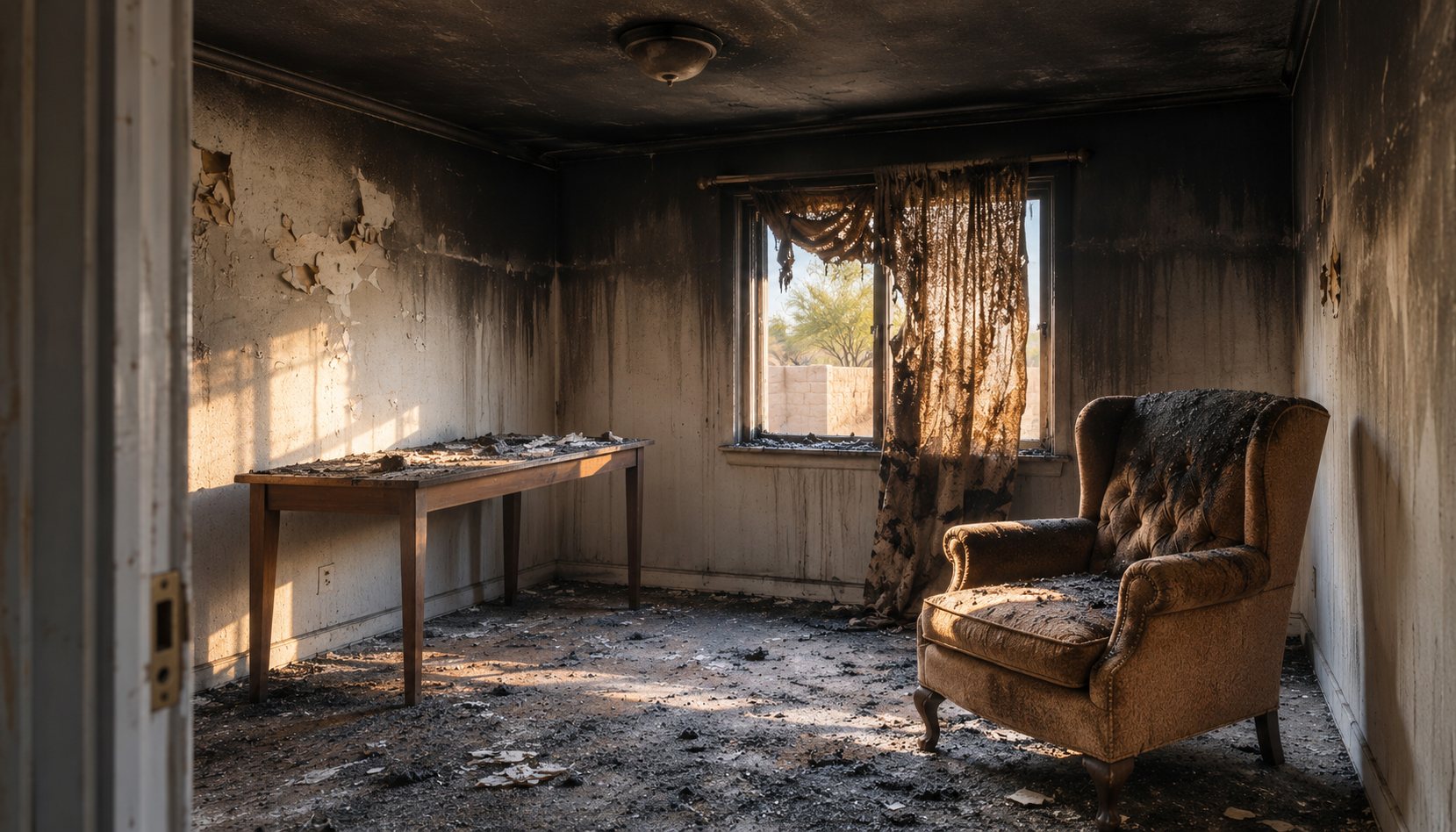
After a house fire, wait for the fire department to clear the building, then document everything, notify your insurer, and get the home secured and drying before soot and water do more damage. The first three days decide a lot: soot keeps etching surfaces, firefighting water soaks deeper into walls and floors, and smoke odor settles into everything porous.
This is the timeline we walk Mesa and East Valley homeowners through after a fire.
Hours 0 to 2: safety first
- Do not go back inside until the fire department says the building is safe. Hot spots, weakened structure and combustion residue make a burned house hazardous.
- Confirm gas, power and water are off or safe. The fire department often handles this; ask before anyone goes back in.
- Find a place to stay. Many homeowners policies include additional living expenses (ALE) while the home is unlivable. Save every receipt.
- Account for everyone, including pets. A pet that was inside should see a vet for smoke exposure.
Hours 2 to 24: document and make the first calls
- When you are cleared to go in, wear a well-fitting N95 mask, gloves, long sleeves and sturdy shoes. Do not touch soot with bare hands.
- Photograph every room before anything moves: wide shots first, then close-ups of walls, ceilings, contents and the area where the fire started. A slow video walkthrough helps.
- Notify your insurance carrier and get a claim number and your adjuster’s contact information. Ask what they need from you before their inspection.
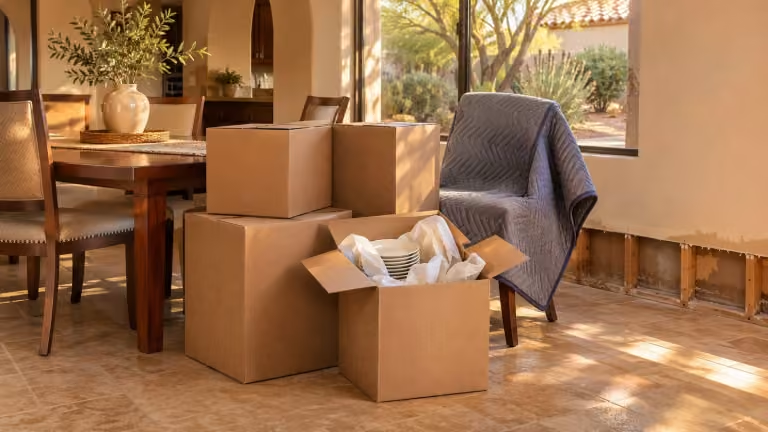
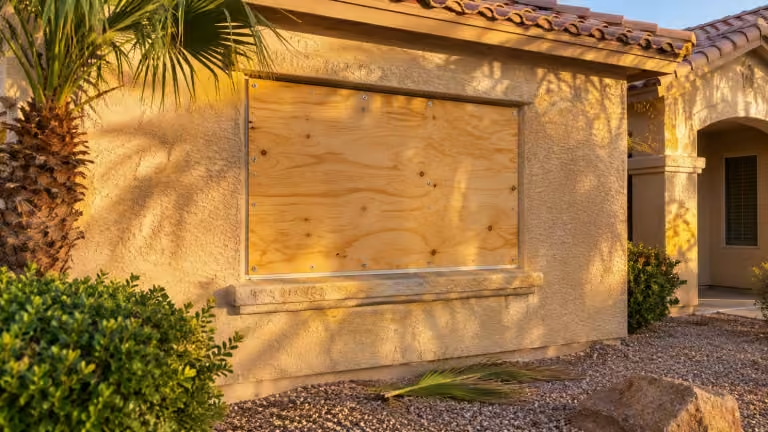
- Call a fire restoration company to secure the property. That usually means board-up of broken windows and doors, tarping roof openings, and extracting firefighting water.
- Do not throw anything away yet. Damaged items still need to be inventoried for the claim.
- Collect IDs, medications, insurance papers and anything else you need to live elsewhere for a while.
- Request a copy of the fire department’s incident report for your insurer.
Days 1 to 3: the water damage nobody sees
Firefighting uses a lot of water, and it soaks drywall, insulation, framing, flooring and contents. In an Arizona summer, a closed-up, wet house heats up fast. EPA recommends drying water-damaged materials within 24 to 48 hours to prevent mold growth, so structural drying needs to start alongside soot work, not after it.
That means extracting standing water, removing saturated materials that cannot be saved, and running dehumidifiers and air movers with daily moisture readings until framing, drywall and flooring are back to dry standard. Our water mitigation crews handle this as part of a fire job.
Older homes: test before tear-out
If your home was built before about 1980, the materials the fire damaged, such as popcorn ceilings, joint compound, old floor tile and mastic, or pipe insulation, may contain asbestos. Fire and the demolition that follows can disturb them. Suspect materials that have to be removed should be sampled and lab-tested before demolition, and anything that tests positive should be removed under containment.
This is about what the materials are, not a blanket rule tied to the home’s age. Whether county asbestos rules apply depends on the type of building; most owner-occupied single-family homes are outside Maricopa County’s notification requirements, while rentals and larger buildings can be covered. Our guide to asbestos in older Arizona homes explains the details.
The four types of soot
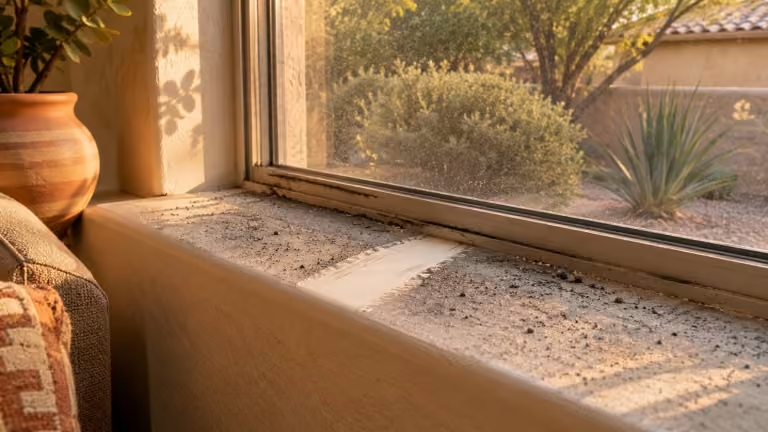
Different fuels leave different residues, and each needs a different cleaning method. The wrong method can set the residue permanently.
Dry soot
Left by fast, hot fires burning paper and wood. Powdery and easier to clean, but it spreads if it is wiped or swept before it is vacuumed.
Wet soot
Left by slow, smoldering fires burning plastics and synthetics. Sticky and smeary. Household cleaning usually makes it worse.
Protein soot
Left by kitchen fires that burn food. It can be nearly invisible, but it leaves a yellowish film and a strong, lingering odor.
Fuel oil soot
Less common in Arizona homes, but it shows up in some garage, equipment and vehicle fires. Heavy and oily, and it needs specialized cleaning.
What can usually be saved
- Hard, non-porous items such as glass, metal and ceramics usually clean up well.
- Sealed wood furniture can often be cleaned, deodorized and refinished.
- Clothing and fabrics often respond to professional cleaning and deodorizing. Do not wash them at home first; heat and household detergent can set the odor.
- Upholstered furniture and mattresses that absorbed heavy smoke or water are often a loss.
- Food, medicine and cosmetics exposed to heat, smoke or firefighting water should be thrown out, including canned goods.
- Electronics should be checked by a professional before you power them on.
- Drywall, insulation and ceiling materials that are charred, soaked or heavily smoked usually need to be replaced.
When a lot of contents need cleaning, a contents packout moves them to our climate-controlled warehouse while the house is restored.
Insurance documentation checklist
- Photos and video of every room, taken before cleanup
- A contents inventory with item, age, approximate cost and condition
- The fire department incident report
- Receipts for emergency costs: hotels, meals, clothing, transportation
- Written estimates for mitigation, cleaning, deodorization and rebuild
- A written record of conversations with your carrier, with dates and names
Our Arizona homeowners insurance guide covers how claims and prompt notice work.
Why DIY fire cleanup backfires
Wiping wet soot with a household sponge smears it deeper into paint and drywall. Many household cleaners react poorly with soot residue. Running the air conditioning spreads smoke particles through the ducts. And anything cleaned or thrown away before the adjuster documents it is harder to claim. Policies also require you to take reasonable steps to prevent further damage, which in practice means getting the home secured and dried quickly.
When to call EA Restoration
Based in Mesa, we handle fire and smoke damage restoration in Mesa and the East Valley, including Gilbert, Chandler, Tempe, Scottsdale, Queen Creek and San Tan Valley, along with communities across Arizona. One team handles board-up, water extraction, soot and odor removal, contents and the rebuild, and we work directly with your insurer.
Call EA Restoration at (480) 636-6619 once the fire department has cleared the scene. We are available 24/7, and we are licensed, bonded and insured (ROC#331767).
Fire Damage FAQs
The kitchen fire was small. Do I still need a restoration company?
Often, yes. Kitchen fires produce protein soot that is hard to see but carries odor through the house, especially if the air conditioning was running. A professional assessment tells you whether it is a cleaning job or a bigger one.
How long does fire damage restoration take?
It depends on the size of the loss. Emergency work such as board-up, water extraction, soot cleaning and odor treatment usually takes days. Rebuilding can take weeks for a single room and months for a large or structural loss.
Can smoke-damaged clothing and furniture be saved?
Many items can. Hard surfaces and sealed wood usually clean well, and many fabrics respond to professional cleaning. Heavily smoked upholstery and mattresses are often a loss, and electronics need to be checked before use.
Is it safe to stay in the house if only one room burned?
Not always. Smoke and soot travel through the home and the HVAC system. Keep the HVAC off until it has been inspected, and have the home assessed before deciding to stay.
My home was built in the 1970s. Do I need asbestos testing after a fire?
Materials that have to be torn out, such as popcorn ceilings, joint compound and old floor tile, should be tested before demolition. If they test positive, they are removed under containment before the rebuild.